
By Bryan Smeltzer
The AI Success Gap: How an Effective Artificial Intelligence Strategy Takes You Beyond the Pilot
Artificial Intelligence Strategy is not about tools. It is about leadership, vision, and designing systems that learn with your organization. Recent research shows that 95% of generative AI pilots deliver no measurable business return. That statistic is shocking until you realize the problem is not the models but how companies lead, integrate, and scale AI. This article lays out a practical, leadership-first framework to turn pilots into performance and build an Artificial Intelligence Strategy that actually delivers.
Table of Contents
- Why pilots fail: the leadership gap behind the numbers
- Six leadership principles for a winning Artificial Intelligence Strategy
- An operational framework: Observe, Define, Create
- What success looks like
- Practical checklist to apply this week
- Closing thought
- FAQ
Why pilots fail: the leadership gap behind the numbers
The headlines focus on investment totals and model breakthroughs, but the real failure mode is organizational. Companies pour billions into AI yet frequently treat it like a plug-and-play technology. They ask how to make today’s work faster instead of asking what new capabilities AI can unlock three to five years from now.
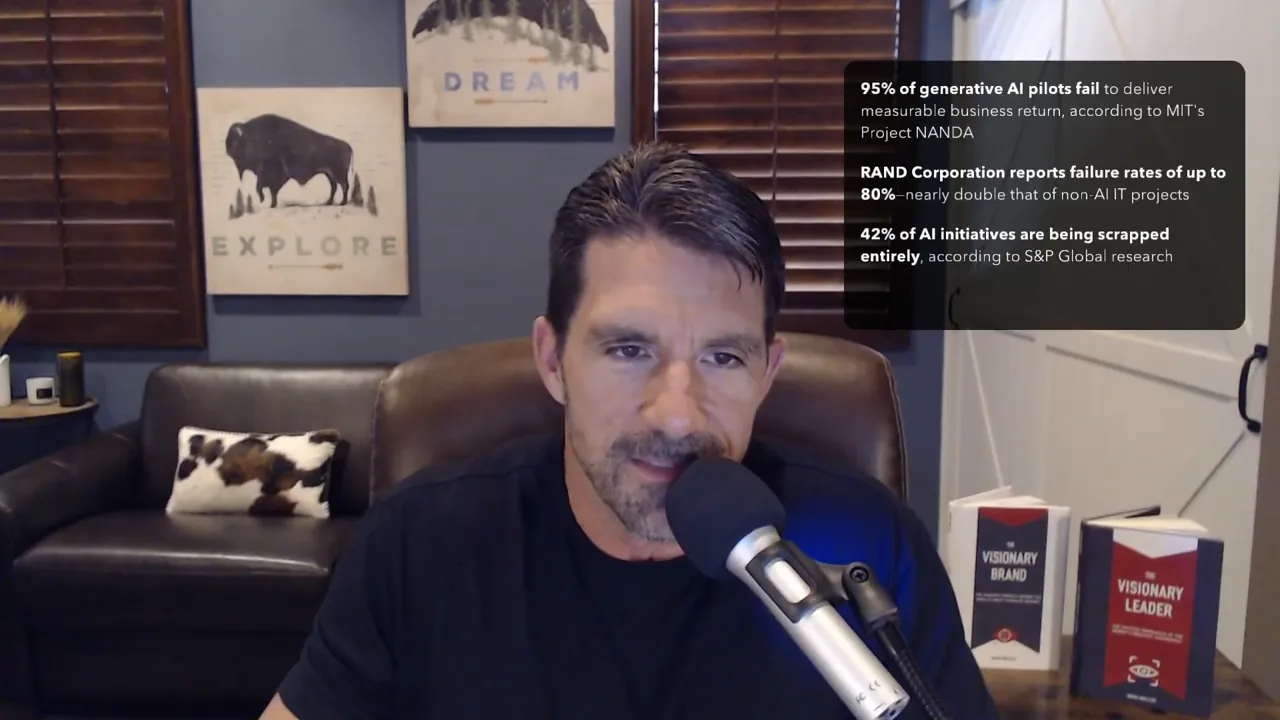
Root causes of failure include poor enterprise integration, brittle static workflows, misaligned expectations, and lack of learning capability. Leaders blame costs, privacy, or regulation, but the heart of the problem is how AI is introduced and governed inside the organization.
Six leadership principles for a winning Artificial Intelligence Strategy
Successful organizations do not chase every shiny tool. They follow leadership principles that turn AI from an expensive pilot into a sustainable competitive advantage.
1. Start with vision, not technology
Define where the organization needs to be in three to five years. Identify capabilities you do not have today and then ask how AI helps build them. When AI projects align with a long-term vision rather than short-term efficiency gains, investments pull together instead of creating patchwork solutions.
2. Understand the landscape before you build
Conduct a targeted analysis of where AI creates genuine competitive advantage in your industry. Focus on customer needs that are evolving and on gaps between current capabilities and future requirements. The 5% who succeed implement AI because they identified strategic opportunities—not because everyone else is doing it.
3. Build adaptive, learning-capable systems
AI is adaptive. Static workflows are not. Invest in systems that learn from your organizational context, create design workflows that evolve, and embed feedback loops so the system improves as people interact with it.
4. Create a culture of experimentation
Encourage teams to test ideas without fear. Reward experiments and treat failures as data points. Start small with pilots designed to scale if they work. View setbacks as iterations on the path to a repeatable solution.
5. Empower teams and secure buy-in
Assemble diverse teams aligned with the vision and give them autonomy. Communicate clearly that AI enhances human capability rather than replaces it. Invest in training so people can work effectively with AI—bringing them along is the single most overlooked determinant of success.
6. Measure what matters and iterate
Define clear success metrics before launch. Build feedback mechanisms, be willing to pivot, and shut down initiatives that do not deliver value. The successful minority concentrates on measurable business impact rather than vanity metrics like number of tools deployed.
An operational framework: Observe, Define, Create
Translate principles into action with a three-step process that connects pilots to performance.
- Observe: Map workflows, identify bottlenecks, and listen to teams about pain points. Distinguish where human expertise is essential and where automation adds complementary value.
- Define: Articulate a clear vision for how AI will transform the organization. Set specific, measurable objectives and connect pilots to future capabilities via a roadmap.
- Create: Launch high-impact, achievable projects that align with the vision. Invest in infrastructure and talent. Build feedback loops, scale successes quickly, and retire what does not work.
What success looks like
The organizations that get it right are not scattered; they are disciplined. They align AI implementation with strategic goals, invest in change management, measure impact consistently, and iterate based on real-world performance. One example projected tens of millions in annual savings from carefully aligned AI programs rather than broad, unfocused deployments.
Practical checklist to apply this week
- Pick one AI initiative and run the Observe, Define, Create process against it.
- Replace the question “what tool should we use” with “what capability do we need in three to five years?”
- Set success metrics up front and require feedback loops before scaling.
- Plan training and change management alongside technical deployment.
Closing thought
Artificial Intelligence Strategy succeeds when it is treated as a leadership challenge, not a technology checkbox. The same principles that distinguish visionary leaders—clear vision, deep understanding of the landscape, adaptability, empowered teams, and ruthless focus on measurable impact—are exactly what transform pilots into lasting advantage. Choose to be deliberate, iterative, and people-centered. The future will reward those who design their AI work around purpose and capability, not hype.
FAQ
What is the main cause of AI pilot failure?
The primary cause is flawed enterprise integration and misaligned expectations. Most failures come from treating AI like a plug-and-play tool rather than embedding it into a clear vision, workflows, and learning systems.
How should leaders measure AI success?
Define clear, business-focused KPIs before launching initiatives. Focus on measurable outcomes like cost savings, revenue impact, customer retention, or time-to-value rather than vanity metrics such as number of tools deployed.
Can small companies succeed with AI or is it only for large enterprises?
Small companies can succeed by prioritizing high-impact projects that align with their strategic vision, investing in adaptable systems, and building strong feedback loops. Being focused and iterative often gives smaller teams an advantage.
What is the first practical step to improve my Artificial Intelligence Strategy?
Run an Observe, Define, Create assessment on one AI initiative. Map current workflows, clarify the three-to-five-year capability you want, set measurable objectives, and design a pilot that can scale if it proves value.
Further resources and links
No external URLs were provided with this request. Below are suggested short anchor texts (1–3 words) where you may want to add links when URLs are available. Replace the placeholder URLs (REPLACE_WITH_URL) with actual destinations.
- AI strategy — resources on building a leadership-first AI roadmap.
- Observe — guidance on mapping workflows and identifying bottlenecks.
- Define — templates for setting measurable objectives and roadmaps.
- Create — best practices for launching scalable pilots and infrastructure.
- feedback loops — examples of operational feedback mechanisms to improve models.
- change management — training and adoption resources for teams.
Suggested placement: add these links inline at relevant sentences — for example, link “AI strategy” in the opening paragraph, “Observe”/”Define”/”Create” in the operational framework section, and “feedback loops” and “change management” where the article discusses iteration and training.
The Visionary Leader eBook! |
|
Get your eBook for Review on Amazon! |
| Click me |
This article was created from the video The AI Success Gap | What Separates Winners from the 95% Who Fail with the help of AI.